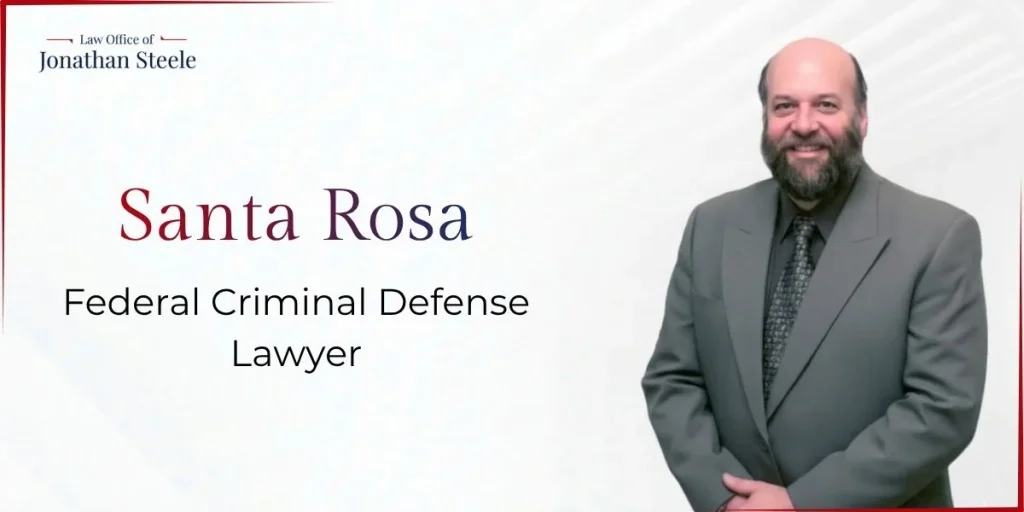
A federal criminal investigation can turn life in Santa Rosa, Sonoma County, and the surrounding North Bay upside down. Federal prosecutors and agencies have substantial resources, and the consequences of a conviction can reach far beyond the courtroom. If you are facing a federal investigation or charge, a Santa Rosa federal criminal defense lawyer can help you understand what is happening, protect your rights, and build a defense tailored to the facts of your situation.
Choosing a lawyer when federal charges are possible is not simply about finding someone who knows criminal law. You need an attorney who takes your situation seriously, communicates with you, and understands what is at stake for your future.
The Law Office of Jonathan Steele is based at 720 Mendocino Avenue in Santa Rosa and has deep roots in Sonoma County. Jonathan B. Steele has more than 25 years of experience handling criminal defense and drunk-driving cases. The firm’s website also identifies practice experience involving criminal law, drug charges, juvenile matters, and sex offenses, among other areas.
That experience matters when the government is investigating you or has already filed charges. Federal cases can involve complicated evidence, multiple agencies, extensive records, confidential informants, digital communications, financial transactions, or conduct occurring across jurisdictional boundaries. A defense cannot be built effectively by looking only at the accusation. The circumstances surrounding the investigation matter, too.
The firm’s approach is also grounded in personal attention. The Law Office of Jonathan Steele describes its attorneys as seasoned lawyers who work hard to protect a client’s credibility throughout the legal process. The firm invites prospective clients to schedule a consultation and emphasizes experienced criminal defense representation.
For Santa Rosa residents, there is another important consideration: local familiarity. Jonathan Steele is a fifth-generation Sonoma County resident, with family roots in the area dating to the 1840s. That longstanding connection to the community helps distinguish a practice that is not simply doing business in Santa Rosa, but is part of the community it serves.
The firm’s philosophy is built around thorough preparation, aggressive representation, reasonable rates, accessibility, and keeping clients informed. Clients should understand what is happening in their cases and why particular decisions are being considered. That kind of communication can be especially valuable when federal proceedings become complicated or move quickly.
Being accused of a crime is frightening under any circumstances. A federal prosecution can feel particularly intimidating because the investigation and prosecution may involve agencies such as the FBI, DEA, ATF, IRS Criminal Investigation, Homeland Security, or federal prosecutors.
Federal criminal cases are prosecuted by the United States government rather than the Sonoma County District Attorney. The federal system also operates under its own statutes, Federal Rules of Criminal Procedure, sentencing framework, and courtroom procedures. The U.S. Courts explains that federal criminal cases begin with the government and generally involve the U.S. Attorney’s Office and, for many serious charges, a grand jury.
That distinction can affect virtually every stage of a case.
A federal investigation may begin long before a person is formally arrested or charged. You might receive a subpoena, be contacted by an agent, learn that your business records have been requested, or discover that investigators are asking questions about you or someone connected to you. That is why waiting until charges are formally filed may not be the right time to seek legal advice.
The phrase federal crime laws encompasses a broad collection of statutes enacted by Congress. Federal offenses can involve conduct occurring on federal property, crimes involving federal agencies, certain interstate activity, financial transactions, controlled substances, firearms, immigration, fraud, organized criminal activity, and numerous other circumstances.
Some conduct can potentially violate both state and federal law. For example, an investigation that begins with local authorities may eventually involve federal agencies or federal prosecutors depending on the facts. Federal prosecutors and state prosecutors operate separately, although investigations can overlap. Common examples of federal criminal allegations can include:
The exact statute charged matters enormously. So do the elements prosecutors must prove. An accusation is not the same thing as proof, and the government carries the burden of proving a defendant guilty beyond a reasonable doubt at trial.
One of the most important things to understand about federal criminal defense is that the courtroom may be only one part of the story.
Federal investigators can spend substantial time gathering evidence before charges are filed. Depending on the investigation, that evidence might include:
An investigation does not automatically mean that charges will follow. It does mean that decisions made during the investigation can have consequences later.
If federal agents want to interview you, for example, you do not have to assume that talking to them is harmless simply because you believe you have done nothing wrong. A statement can be misunderstood, taken out of context, or later used as evidence. Speaking with a defense lawyer before responding can help you understand your options.
Federal criminal procedure follows a different path from many state cases. Depending on the circumstances, a federal case can begin with a criminal complaint, indictment, or information. In felony cases, an indictment by a grand jury is generally required unless the defendant waives that right. The general process may involve:
The process is not identical in every federal case. Some cases are resolved early. Others involve lengthy investigations, complex motions, extensive discovery, or trial.
One of the biggest mistakes defendants can make is assuming that every federal charge carries one predictable punishment.
Federal crime penalties depend on the specific statute, the alleged conduct, the defendant’s criminal history, applicable enhancements, loss amounts or drug quantities where relevant, and other facts. Potential consequences can include incarceration, supervised release, fines, restitution, forfeiture, and other restrictions.
Federal sentencing also involves the U.S. Sentencing Guidelines. The Guidelines are advisory rather than automatically binding, but judges consider them along with other relevant sentencing information.
A presentence investigation can become particularly important. The resulting report may address the offense, criminal history, personal and social history, applicable advisory Guidelines, and victim-impact information. Defense counsel and the defendant generally have an opportunity to review the report and raise concerns about its accuracy before sentencing.
That makes sentencing preparation a critical component of federal defense.
A lawyer should not wait until the day of sentencing to start thinking about the factors that could affect the outcome. Where appropriate, the defense may need to develop evidence concerning employment, family responsibilities, community ties, treatment, rehabilitation, financial circumstances, mental health or substance-use history, or other mitigating considerations.
There is no universal defense strategy for federal criminal cases. A defense must be based on the government’s actual evidence and the legal requirements of the charged offense. Depending on the circumstances, an attorney may investigate questions such as:
These questions illustrate why federal defense is about much more than standing in court and arguing against an accusation.
A federal judge can dismiss charges in circumstances recognized by law, although dismissal is not guaranteed simply because the defense disputes the government’s allegations. Potential grounds can involve constitutional violations, defects in the charging document, limitations on prosecution, insufficient legal basis, or other procedural problems. Whether dismissal is appropriate depends heavily upon the particular circumstances and governing federal law.
Yes. A federal indictment may contain multiple counts when prosecutors believe the evidence supports separate offenses arising from related or unrelated conduct. Additional charges can sometimes create substantially different legal exposure, depending on whether sentences may run concurrently or consecutively. Careful examination of each count is therefore essential because one investigation can potentially produce several distinct allegations.
Property seized during a federal investigation may remain in government custody while authorities determine its evidentiary or legal significance. Depending on the circumstances, property can potentially become subject to forfeiture proceedings. Ownership, timing, statutory authority, and the government’s theory all matter. A property owner may have specific procedures available for contesting the government’s effort to retain or forfeit assets.
Potentially, yes. Public posts, messages, photographs, videos, account information, and other digital material may become relevant to a federal investigation or prosecution. Authenticity and context can become important issues, particularly when posts are incomplete, misunderstood, altered, or presented without surrounding communications. People facing an investigation should avoid assuming that online activity is irrelevant simply because it occurred outside a courtroom.
Federal charges can put your freedom, finances, reputation, and future at serious risk. You deserve more than vague answers and a lawyer who treats your case like a number. Hire a federal defense lawyer who can listen, investigate aggressively, explain your options, and work to protect your rights from the first conversation forward. Contact the Law Office of Jonathan Steele today to schedule your consultation and take control of what comes next.
Fields Marked With An “*” Are Required
"*" indicates required fields

720 Mendocino Ave.
Santa Rosa, CA 95402
Mon – Fri | 8:00 am – 5:00 pm
Sat – Sun | Closed
© 2026 Law Office of Jonathan Steele • All Rights Reserved. *Images are obtained under license from Canva and other third-party stock image providers, with attribution included where required. Disclaimer | Site Map | Privacy Policy. Digital Marketing By: 

